
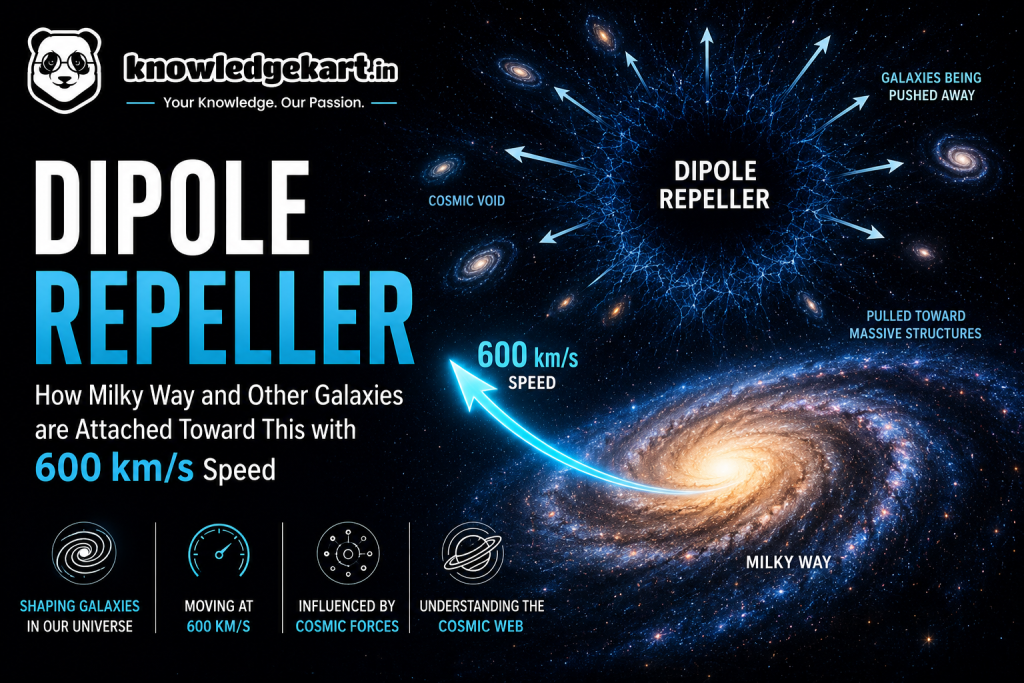

For decades, astronomers believed gravity alone dictated the motion of galaxies across the universe. Massive galaxy clusters pull neighboring systems toward them, creating an intricate cosmic dance shaped by attraction. But modern observations have revealed something even more fascinating: our Milky Way is not only being pulled—it is also being pushed. The Dipole Repeller: The Cosmic Force Steering Our Galaxy at 600 km/s
This mysterious phenomenon is known as the Dipole Repeller, a vast region of space that appears to repel galaxies, influencing the motion of our cosmic neighborhood at extraordinary speeds.
What Is the Dipole Repeller?
The Dipole Repeller is a massive underdense region in the universe—a gigantic cosmic void containing far less matter than average. Unlike galaxy clusters, which exert strong gravitational attraction, a void creates the opposite effect.
Technically, empty space does not “push” objects away. Instead, regions rich in matter pull more strongly, while regions with less matter pull weakly. The result creates the appearance of repulsion.
Think of it like this:
Imagine standing between two groups of people in a tug-of-war. One side has 100 people pulling, the other side has only 10. You move toward the stronger side—not because the weaker side pushes you, but because it pulls less.
That is essentially what happens with galaxies near the Dipole Repeller. The Dipole Repeller: The Cosmic Force Steering Our Galaxy at 600 km/s
The Milky Way’s Surprising Motion
Astronomers have measured that the Milky Way galaxy, along with the Local Group of galaxies, is moving at roughly 600 kilometers per second relative to the cosmic microwave background—the afterglow of the Big Bang.
That means every second, our galaxy moves about 600,000 meters, or over 2.1 million kilometers per hour.
This motion puzzled scientists for years.
Initially, researchers believed the movement was caused entirely by the gravitational pull of massive structures like:
- The Great Attractor
- Shapley Supercluster
- Nearby galaxy concentrations
But observations showed that attraction alone did not fully explain the motion. The Dipole Repeller: The Cosmic Force Steering Our Galaxy at 600 km/s
Discovery of the Dipole Repeller
In 2017, astronomers mapping the velocities of thousands of galaxies discovered something remarkable.
By tracing galaxy movement backward, they identified a large empty region in the opposite direction of the Milky Way’s motion.
This region became known as the Dipole Repeller.
Its significance was profound:
- The Milky Way is being pulled toward dense regions like the Shapley Supercluster
- Simultaneously, it is moving away from the underdense Dipole Repeller
- Together, these forces shape our galaxy’s path through space
This was one of the first major confirmations that cosmic voids significantly influence galaxy motion.
How Other Galaxies Are Affected
The Dipole Repeller doesn’t only influence the Milky Way.
Entire groups and clusters of galaxies are affected by the same large-scale gravitational flows.
Galaxies are connected through what astronomers call the cosmic web:
- Filaments of dark matter
- Massive galaxy clusters
- Vast empty voids
- Interconnected gravitational flows
Within this network:
- Matter streams toward dense clusters
- Away from low-density voids
- Creating enormous bulk flows across millions of light-years
This means many galaxies in our local universe are participating in the same large-scale motion.
Is the Universe Pulling or Pushing?
The answer is both—but technically mostly pulling.
Gravity is always attractive.
What appears to be “repulsion” is simply weaker gravitational attraction from an emptier region.
So the Dipole Repeller is not some anti-gravity engine.
Instead, it is evidence that absence of matter can shape cosmic motion almost as dramatically as presence of matter.
Why This Discovery Matters
The Dipole Repeller helps scientists understand:
1. Large-Scale Cosmic Structure
It confirms that the universe behaves like a vast interconnected web rather than isolated galaxies.
2. Dark Matter Distribution
Galaxy motions reveal where unseen mass likely exists.
3. Cosmic Evolution
Tracking galaxy flows helps reconstruct how the universe evolved after the Big Bang.
4. Better Cosmological Models
It improves simulations explaining matter distribution across billions of light-years.
Final Thoughts
The idea that our Milky Way is racing through space at 600 km/s, influenced not only by massive galaxy clusters but also by enormous cosmic voids, changes how we view the universe.
The Dipole Repeller reminds us that in cosmology, even emptiness has power.
Sometimes, what isn’t there can shape reality just as much as what is.
UPSC Topper’s Strategy By Srushti Jayant Deshmukh
Mulakaram The Breast Tax and Woman Empowerment for UPSC IAS Exam
UPSC Full Form and All Details of UPSC
The Ultimate Guide to Indian Geography: Complete Video Series for IAS


